Nothing is authentic on the internet and you're likely a target of stock-market boosting campaigns.
Wired is out with an interesting article about a Brooklyn rock band called Geese that had a monster 2025. Their album Getting Killed landed on every year-end list that mattered. They booked Saturday Night Live. They sold out a fall tour. The Guardian called them "the new saviors of rock 'n' roll."
Then the curtain got pulled back.
A digital marketing firm called Chaotic Good Projects confirmed to WIRED today that it ran campaigns for the band — creating networks of TikTok accounts, seeding clips into recommendation algorithms, and manufacturing the appearance of organic grassroots buzz. The firm's cofounder told Billboard they "know how to go viral" and have "thousands of pages" at their disposal. He calls the technique "trend simulation."
Read that term again: trend simulation.
Now ask yourself a very simple question: if this works for music, why wouldn't it work for stocks?
The playbook is straightforward. You build a constellation of accounts across social platforms. You seed content — clips, commentary, reactions — that looks organic. You manufacture engagement that triggers the recommendation algorithm, which surfaces the content to real users, who then amplify it further. The fake spark lights a real fire.
Chaotic Good was doing this on TikTok and YouTube. But the same architecture maps perfectly onto financial social media — StockTwits, Reddit's r/wallstreetbets, FinTwit, YouTube finance channels, TikTok finance creators.
And in markets, engagement is price action. Now that might not always be positive (though it generally is) but at least it's volume.
You'd Be Naive to Think This Isn't Already Happening
Social media sentiment now feeds directly into algorithmic trading models. Retail investor flows are influenced by what trends on Reddit and TikTok. A coordinated campaign that makes a stock look like it has organic momentum can generate actual momentum — at least for a while.
Take a name like Palantir Technologies (PLTR). The stock has been a retail darling, trading at valuations that have made traditional analysts choke on their spreadsheets. The bull case rests on genuine tailwinds — government AI contracts, commercial expansion, the broader AI narrative. But scroll through the social media discourse around PLTR and you'll notice something familiar: an almost suspiciously uniform enthusiasm, an ecosystem of accounts that seem to exist primarily to amplify one thesis, and a volume of engagement that feels engineered.
I'm not saying Palantir is running trend simulation campaigns. I have no evidence of that. But I am saying that if you wanted to run one on a stock with a devoted retail following and a momentum-driven price structure, PLTR would be the template and it took off around the same time as these techniques started to become more widespread. The characteristics that make a stock susceptible to this are well understood: high retail ownership, strong narrative appeal, options-heavy trading, and a community that wants to believe.
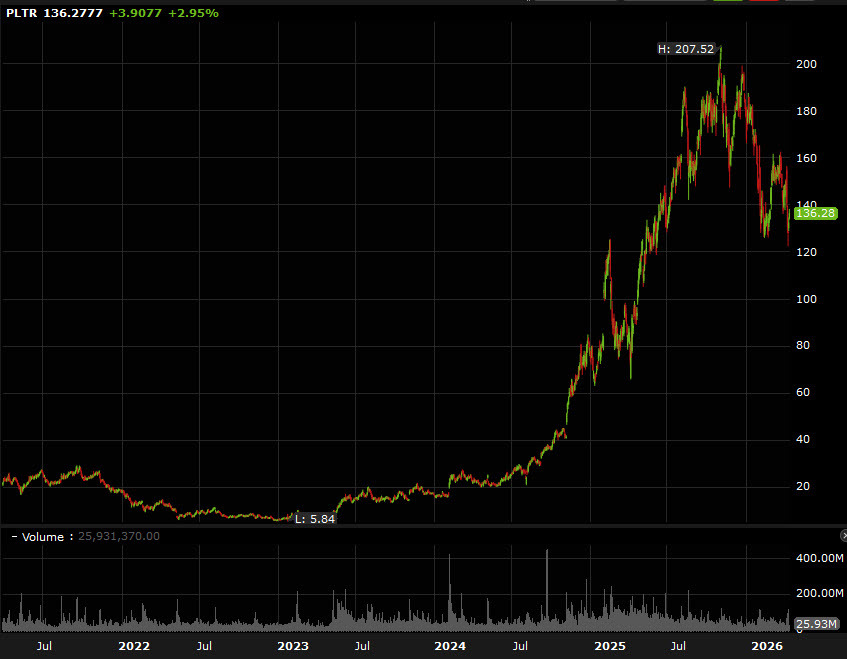
- Trailing P/E 217x (111x forward)
- EV/EBITDA 206x
- Price-to-sales 80x
The same profile fits a dozen other names on any given day.
As a trader, there are two ways to think about this. One is to find one of these psyops that's started and get in early and hold on for dear life. With the advent of OpenClaw and other AI tools, I imagine that the campaigns that were once spun up by these firms and IR departments will be possible via a guy and a laptop.
Otherwise, steer clear of these battleground stocks. I think it's going to be tougher to discern what's authentic and what's real enthusiasm. Ultiamtely, you can't fake earnings (or not for long). If your thesis on a stock is primarily informed by social media sentiment, you don't have a thesis.
One of Chaotic Good's founding partners summed up the firm's philosophy in an interview with Billboard: "Everything on the internet is fake."
It's a glib line, but it contains a real warning for market participants. The infrastructure for manufacturing consensus is cheap, scalable, and increasingly sophisticated. The platforms that surface content to you are optimized for engagement, not accuracy. And the line between organic enthusiasm and paid amplification is, by design, invisible.
In the music industry, the worst-case outcome of trend simulation is that you buy a concert ticket for a band you end up not liking. In financial markets, the stakes are meaningfully different.
Earnings are real. Revenue is real. Cash flow is real. Everything else is a story — and now we know, with uncomfortable specificity, how easy those stories are to manufacture.
Anyway, here's Geese, decide for yourself: